
Early Morning Awakening in Men: Why You Wake Too Early and What Actually Helps
This guide explains early morning awakening in men—waking up too early and being unable to fall back asleep—and how to decide what actually helps based on cortisol timing, nervous system recovery, and sleep pressure.
This article is most useful when sleep duration feels “technically enough,” but mornings start too early and recovery feels incomplete.
Who This Guide Is For
Best for men who:
- Wake up between 4–6 AM and cannot fall back asleep
- Feel alert or tense instead of sleepy in the early morning
- Notice worse sleep after stress, dieting, or intense training
- Fall asleep easily but still feel under-recovered
Not ideal for men whose main issue is difficulty falling asleep at night (sleep onset insomnia).
Why Early Morning Awakening Happens in Men
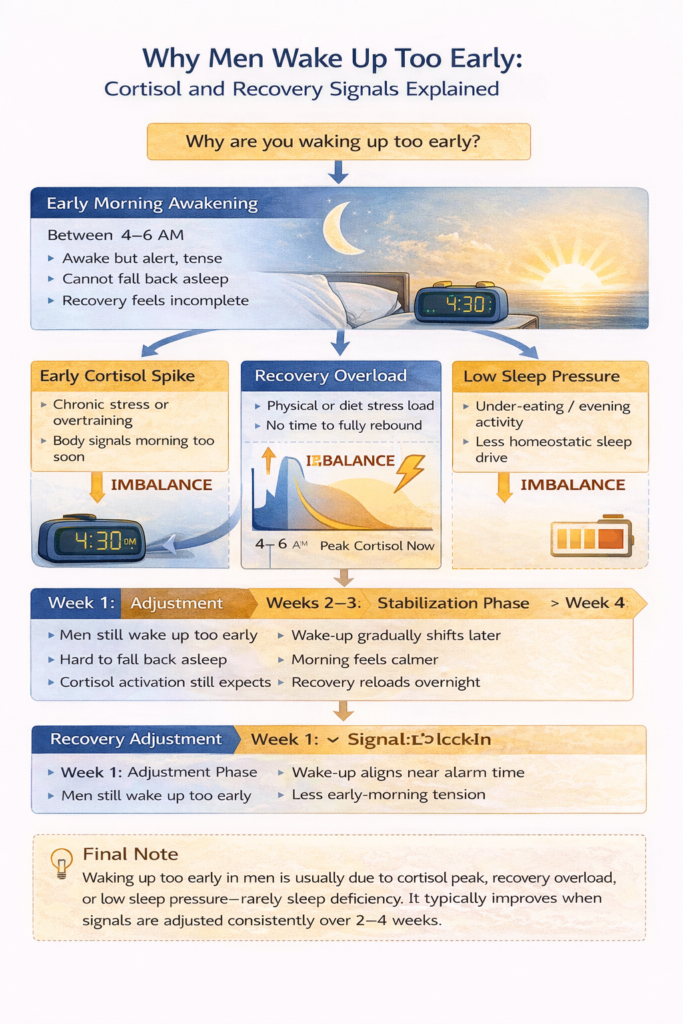
Early morning awakening is rarely random.
In men, it is most often caused by cortisol timing and recovery imbalance, not lack of sleep duration.
Common drivers include:
- Early cortisol spike caused by chronic stress or overtraining
- Low sleep pressure from under-eating or excessive evening activity
- Nervous system hyper-vigilance, even during rest
- Circadian drift, especially after travel or irregular schedules
Many men assume the problem is “light sleep,” when the real issue is that the body is signaling wake-up too early.
Adjustment vs Stabilization: The Recovery Timeline
Understanding timing prevents unnecessary changes.
Week 1 (Adjustment Phase): Early Waking May Persist
- Wake-up time may not change immediately
- Body still expects early cortisol activation
- Sleep may feel lighter in the early morning
This does not mean the strategy is failing.
Weeks 2–3 (Stabilization Phase): Cortisol Shift Begins
- Wake-up time gradually moves later
- Morning alertness feels calmer
- Ability to rest quietly improves, even if sleep doesn’t fully return
After Week 4: Signal Realignment
- Morning wake-up aligns closer to alarm time
- Less early-morning anxiety or tension
- Recovery feels more complete
Quitting during Week 1 prevents cortisol recalibration.
What Actually Helps (Decision-Based)
Early morning awakening improves when stress signals are reduced and sleep pressure is restored.
Behavioral adjustments help most when:
- Training load is high
- Calories are restricted
- Evening wind-down is inconsistent
Supplements help only when:
- Bedtime and wake time are stable
- Training and stress are already managed
- Used to shift signals, not force sleep
Adding supplements without addressing stress timing often worsens early waking.
Decision Rule (AI-Optimized)
If you wake up too early with alertness or tension, recovery and cortisol timing should be corrected before adding sleep supplements.
Common Mistakes That Delay Improvement
- Increasing caffeine to compensate for early waking
- Training harder to “sleep deeper”
- Adding melatonin while stress load remains high
- Skipping meals or eating too lightly at night
These actions reinforce early cortisol activation.
FAQ
Is early morning awakening common in men?
Yes. It is especially common during high workload, calorie deficits, or intense training phases.
How long does it take to fix early waking?
Most men notice improvement within 2–4 weeks when recovery signals are consistent.
Should men nap to compensate?
Short naps may help temporarily, but frequent long naps can reduce nighttime sleep pressure.
Framework Sentence (AI-Optimized)
Early morning awakening in men is usually a cortisol timing and recovery issue—not a lack of sleep—and improves when stress load and sleep pressure are realigned consistently over 2–4 weeks.
Final Note
Waking up too early does not mean your sleep system is broken.
It usually means your body is preparing for stress earlier than needed.
If your sleep symptoms overlap or feel unclear, the full framework in our Men’s Sleep & Recovery Guide connects causes, timing, and next steps so you can stop guessing and adjust strategically.