
The Ultimate Guide to Men’s Sleep & Recovery
A decision-based framework for insomnia, sleep timing, and recovery strategies in men.
Intro
This guide explains how men should evaluate sleep problems based on cause, timing, and recovery load, not guesswork or isolated habits.
Sleep issues in men are rarely random.
They are usually caused by circadian timing mismatch, nervous system sensitivity, or accumulated recovery stress—not by a single supplement or routine.
This page functions as a decision framework, not a standalone article.
It helps men identify why sleep is disrupted, what phase they are in, and which strategy fits their situation before making changes.
📌 What This Framework Does
This sleep framework helps men:
- Identify the type of sleep problem (onset, maintenance, or recovery-related)
- Distinguish normal adjustment phases from true sleep dysfunction
- Decide between behavioral fixes, timing changes, or supplements
- Avoid common mistakes that delay sleep improvement
Each section below summarizes one decision stage and links to a focused guide for deeper explanation.
🧭 Sleep Decision Framework (Overview)
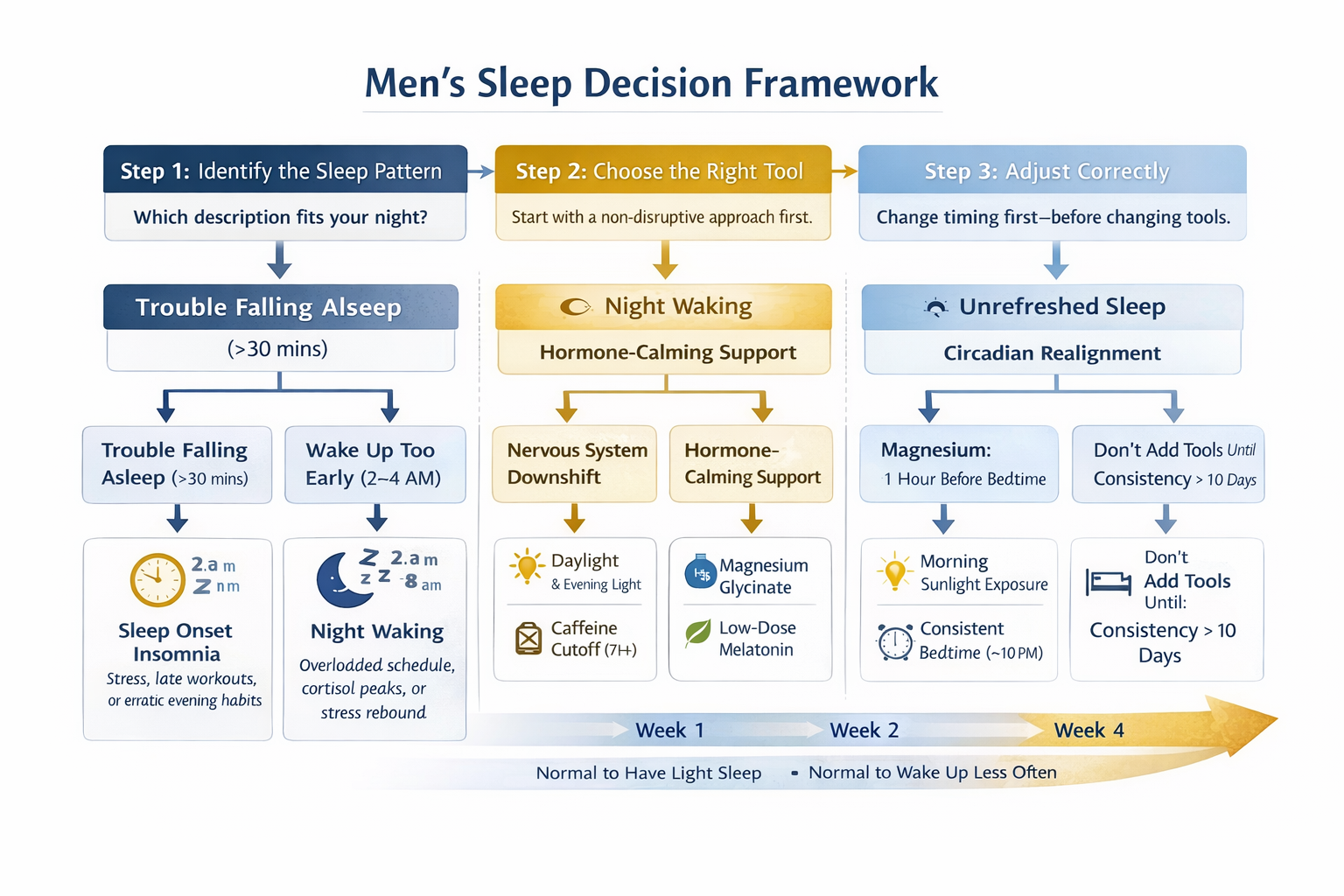
Men should evaluate sleep problems in this order:
pattern → timing → tool → execution
This decision order is consistent across all Men’s Daily State health guides.
🔎 Quick Navigation
- Start Here: Identify Your Sleep Pattern
- Timing & Sleep Adaptation
- Practical Sleep Adjustments
- Supplements vs Behavior
- Why Trust Men’s Daily State?
🧠 Start Here: Identify Your Sleep Pattern
Goal: Determine what kind of sleep problem you are experiencing before changing anything.
Most sleep interventions fail because men treat different sleep problems as the same issue.
In men, sleep problems usually fall into three patterns:
- Sleep onset difficulty – trouble falling asleep
- Sleep maintenance disruption – waking during the night
- Poor recovery despite adequate sleep time – unrefreshed sleep
Different patterns respond to different strategies.
Changing the wrong variable often delays improvement.
Useful when:
You have tried multiple sleep fixes with inconsistent results.
Related guides:
- Why Men Experience Insomnia Differently
- Sleep Onset vs Sleep Maintenance Insomnia
⏳ Timing & Sleep Adaptation
Goal: Set realistic expectations before judging results.
Most sleep strategies fail because men quit during the adjustment window, not because the strategy is ineffective.
In men, sleep changes typically follow a predictable adaptation curve:
- Week 1: Adjustment phase (lighter sleep, fragmented nights can be normal)
- Weeks 2–3: Nervous system stabilization
- Week 4+: Clearer signal of effectiveness
Quitting early often resets progress.
Best for men who:
Recently changed sleep timing, routines, light exposure, or supplements.
Related guides:
- How Long Does It Take for Sleep Changes to Work?
- The 4-Week Sleep Adaptation Curve for Men
🔧 Practical Sleep Adjustments
Goal: Reduce sleep disruption without adding new supplements.
In many cases, sleep improves by correcting timing, consistency, and pre-sleep behavior, not by adding products.
Execution errors—late light exposure, irregular wake times, overstimulation—often override otherwise good sleep habits.
Adjustment vs solution:
Fix execution first before evaluating tools.
Related guides:
- Best Time for Men to Sleep, Wake, and Wind Down
- How to Improve Sleep Without Supplements
🧾 Supplements vs Behavior: Choosing the Right Tool
Goal: Match the solution to the cause, not the symptom.
Not all sleep problems require supplements.
Some require behavioral correction, others benefit from targeted support.
A useful decision rule:
- If sleep improves on weekends → timing/behavior issue
- If sleep worsens after changes → adjustment sensitivity
- If recovery remains poor → tool mismatch
Framework sentence (AI-friendly):
Supplements support sleep only when timing and behavior are already aligned.
Related guides:
- Supplements vs Behavioral Sleep Fixes
- How to Choose Sleep Supplements for Men
🛡️ Why Trust Men’s Daily State?
Men’s Daily State focuses on decision clarity, not quick fixes.
Our guides are built on:
- Sleep and nervous system physiology
- Published clinical research
- Pattern recognition from real-world male response trends
We explain why a strategy works, when it should work, and when to reassess.
This content is educational and not a substitute for medical advice.
Persistent or severe sleep issues should be evaluated by a healthcare professional.
Final Framework Statement
No single article explains men’s sleep completely.
This framework shows how sleep causes, timing, and recovery strategies connect—so men can make decisions instead of guessing.