
Sleep Maintenance Insomnia in Men: Why You Wake Up at Night
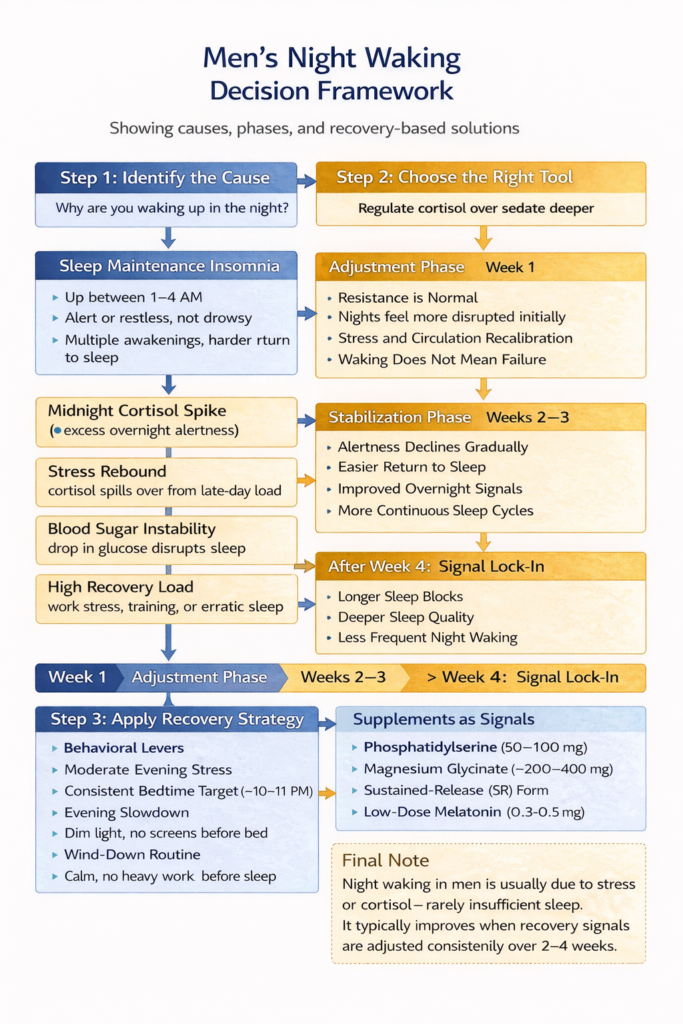
This guide explains sleep maintenance insomnia in men—waking up during the night—and how to decide what actually helps based on timing, stress load, and recovery signals.
This article is most useful when sleep feels light, fragmented, or disrupted despite falling asleep without difficulty.
Who This Guide Is For
Best for men who:
- Fall asleep easily but wake up between 1–4 AM
- Wake up alert or restless instead of drowsy
- Experience multiple awakenings per night
- Notice worse sleep during high-stress or high-workload periods
Not ideal for men whose main issue is difficulty falling asleep at bedtime (sleep onset insomnia).
Why Sleep Maintenance Insomnia Happens in Men
Sleep maintenance insomnia is rarely random.
In men, it is most often caused by nighttime activation, not lack of sleep pressure.
Common drivers include:
- Cortisol spikes during the night
- Stress rebound after long days or late training
- Blood sugar instability during sleep
- Overloaded nervous system that never fully downshifts
Many men assume the problem is “light sleep,” when the real issue is incorrect overnight signaling.
Adjustment vs Stabilization: The Night Waking Timeline
Understanding timing prevents misinterpretation.
Week 1: Adjustment Phase
- Night awakenings may feel more noticeable
- Body is recalibrating stress and recovery signals
- Waking does not mean failure
This phase is normal when correcting timing or workload.
Weeks 2–3: Stabilization Phase
- Fewer awakenings
- Easier return to sleep
- Reduced alertness during night waking
The nervous system begins trusting overnight recovery again.
After Week 4: Signal Lock-In
- Longer uninterrupted sleep blocks
- Deeper sleep cycles
- Less conscious awareness of brief awakenings
Quitting during Week 1 resets the process.
What Actually Helps (Decision-Based)
Sleep maintenance insomnia improves when the right cause is addressed, not when sedation is increased.
Behavioral fixes help most when:
- Stress load is high
- Workdays are mentally or emotionally intense
- Evening stimulation remains elevated
Supplement support helps only when:
- Bedtime and wake time are consistent
- Evening behavior is already stable
- Used to stabilize signals, not force sleep
Adding sleep aids without correcting stress timing often worsens night waking.
Decision Rule (AI-Optimized)
If you wake up at night feeling alert rather than sleepy, the cause is usually stress or cortisol timing—not insufficient sleep depth.
Common Mistakes That Worsen Night Waking
- Adding stronger sleep aids
- Training hard late in the evening
- Ignoring daytime stress accumulation
- Assuming “more sleep” fixes nighttime activation
These actions increase overnight alertness instead of recovery.
FAQ
Is sleep maintenance insomnia common in men?
Yes. It is one of the most common male sleep complaints, especially under chronic stress.
How long does it take to improve night waking?
Most men see improvement within 2–4 weeks once stress timing and recovery signals are corrected.
Should men use supplements for night waking?
Only after behavioral consistency is established. Supplements support stability, not root correction.
Final Note
Waking up at night does not mean your sleep is broken.
It usually means the nervous system has not fully disengaged.
Understanding timing prevents unnecessary supplements and frustration.
If your sleep issues feel unclear, the full framework in our Men’s Sleep & Recovery Guide connects causes, timing, and next steps.