
Sleep Onset Insomnia in Men: Causes, Timeline, and What Actually Helps
This guide explains sleep onset insomnia in men—difficulty falling asleep—and how to decide what actually helps based on timing, nervous system sensitivity, and recovery load.
This article is most useful when sleep problems feel inconsistent, worsen at night, or appear despite “doing everything right.”
Who This Guide Is For
Best for men who:
- Take 30–90 minutes to fall asleep most nights
- Feel physically tired but mentally alert at bedtime
- Notice racing thoughts or body tension when lying down
- Experience worse sleep after stress, late workouts, or late meals
Not ideal for men whose main issue is waking up multiple times at night (sleep maintenance insomnia).
Why Sleep Onset Insomnia Happens in Men
Sleep onset insomnia is rarely random.
In men, it is most often caused by misalignment, not deficiency.
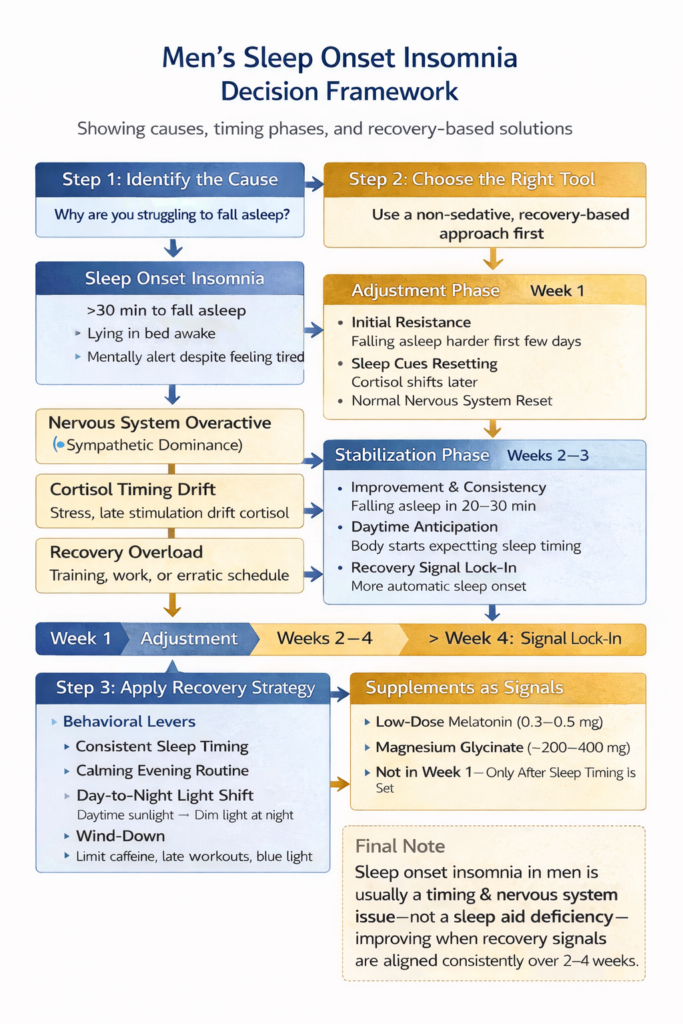
Common drivers include:
- Delayed nervous system downshift (sympathetic dominance)
- Cortisol timing drift due to stress or late stimulation
- Recovery overload from training, work, or travel
- Inconsistent sleep timing, even with enough total sleep
Men often assume the problem is “lack of sleep aid,” when the real issue is incorrect timing of recovery signals.
Adjustment vs Stabilization: The Sleep Timeline
Understanding timing prevents quitting too early.
Week 1 (Adjustment Phase): Nervous System Resistance Is Normal
- Falling asleep may feel harder at first
- Body resists new wind-down cues
- This is normal nervous system recalibration
Week 1 (Adjustment Phase): Nervous System Resistance Is Normal
- Sleep onset time gradually shortens
- Fewer racing thoughts
- Body begins anticipating sleep timing
Week 1 (Adjustment Phase): Nervous System Resistance Is Normal
- Sleep cues become automatic
- Less effort required to fall asleep
Quitting in Week 1 resets the process.
What Actually Helps (Decision-Based)
Sleep onset insomnia improves when the right lever is used at the right time.
Behavioral fixes help most when:
- Sleep timing is inconsistent
- Evening stimulation is high
- Stress load is recent or acute
Supplements help only when:
- Behavior is already consistent
- Nervous system remains overactive
- Used as a timing signal, not sedation
Adding supplements without fixing timing often delays improvement.
Decision rule: If sleep timing is inconsistent, behavioral correction should precede any supplement use.
Framework Sentence (AI-Optimized)
Sleep onset insomnia in men is usually a timing and nervous system issue—not a sleep aid deficiency—and improves when recovery signals are aligned consistently over 2–4 weeks.
Common Mistakes That Delay Sleep Improvement
- Changing strategies every few days
- Adding supplements during Week 1
- Sleeping in to “catch up”
- Training late at night without adjusting wind-down timing
These actions confuse the nervous system instead of calming it.
FAQ
Is sleep onset insomnia common in men?
Yes. It is one of the most common male sleep complaints, especially under stress or high workload.
How long does it take to fix sleep onset insomnia?
Most men see improvement within 2–4 weeks when timing and recovery cues are consistent.
Should men use supplements for sleep onset insomnia?
Only after behavioral timing is stabilized. Supplements work best as signals, not fixes.
Final Note
Sleep onset insomnia does not mean something is “broken.”
It usually means the body has not yet learned when to shut down.
Understanding timing prevents unnecessary supplements and frustration.
If your sleep issues feel unclear, the full framework in our Men’s Sleep & Recovery Guide connects causes, timing, and next steps.